

Bureaucracy is a well-known problem within larger organizations.
Large organizations accumulate processes as a defense mechanism. Every past mistake gets a procedure. Every risk gets a committee. Over time, the organization optimizes for not failing rather than moving forward. The result:
Decision velocity drops: approvals travel up and down hierarchies instead of happening at the point of knowledge
Resources get locked — budgets are allocated annually to existing lines, not dynamically to new opportunities
Talent gets frustrated — people who joined to build things spend their time in governance meetings
Small companies don't have this. They move fast by default, not by effort.
One crucial way bureaucracy hampers large organizations is in the approval of employee ideas. In our experience, most larger organizations lack efficient processes for quickly capturing ideas from their workforce and refining, evaluating, testing, and implementing them. Each level within the organization has its own set of resistors that slow the process of moving an innovation from idea to implementation.
For example, if a frontline employee has an idea about how a new technology could disrupt the current business model and how to protect against it, their idea often has to go through many levels before approval. It is first sent to their manager, then to the manager’s superior, through several other levels of approval, and only after that might it be implemented. During this time, smaller, more agile companies get their ideas to the market and iterate on them much faster, potentially giving them a significant advantage.
One of our clients, Faisal Alqethami, encountered these issues at Al Rajhi Bank and Riyad Bank and discovered an effective way to bypass formal corporate structures, enabling these large banks to be nimble and quickly capture, test, and implement ideas. This led to 1000+ idea submissions, with 18+ successfully implemented.
Case Study #1: Implementing an Innovation Process at Al Rajhi Bank
Problem: Employee ideas must pass through several levels of approval, which can take months or even years before they are tested or implemented.
Solution: Al Rajhi launched the Al Rajhi Innovation Center, powered by InnovationCast, where employees can submit ideas that reach the CEO, and the best are implemented.
Results: Al Rajhi Bank launched banking innovations such as a Gift Card and IT Operations Platform, among others.
Faisal joined Al Rajhi Bank in 2020 as the head of innovation.
He was hired directly by the CEO, who recognized that the company had thousands of employees brimming with valuable ideas, but no clear channel for them to be heard. He felt the potential of some of the brightest minds was untapped.
The CEO wanted to establish an innovation system that captures ideas from any of the company’s 12,000+ employees, evaluates and tests them, and turns them into revenue or cost savings.
Essentially, the CEO needed ideas to sidestep formal corporate structures so Al Rajhi Bank could be more nimble.
Al Rajhi Bank’s strategy can be broken down into three stages.
Develop an innovation system that enables ideas to bypass corporate structures.
Implement an ambassador program to encourage the entire workforce to brainstorm and submit high-quality ideas.
Present the best ideas to the CEO and other stakeholders.
Stage 1: Create an Innovation System Independent of Slower Corporate Structures
To avoid bureaucracy, Al Rajih created a digital innovation center called Al Rajhi Bank Innovation Center, hosted on InnovationCast. Here, employees can submit ideas, view their colleagues' ideas, and collaborate to refine them. The best ideas go directly to the CEO and key stakeholders for evaluation.
So, if an employee working in CX has an idea but his manager doesn’t listen, or it must pass through several approval levels, he can submit it here. It sidesteps everyone and goes straight to the CEO. Before this, nobody at Al Rajhi offered this value.
It’s also important to emphasize that we didn’t want the innovation center to be a digital idea box that leaves no room to improve ideas after they're submitted. Idea improvement is necessary because first-draft ideas often have flaws and are rarely ready to implement. They require multiple competencies to think through the idea and work with the original contributor to improve it.
So, Al Rajhi intentionally designed the innovation center to allow employees to see their colleagues’ ideas, use their expertise to identify weaknesses and potential solutions, and co-create to strengthen them. This co-creation was fundamental to the quality of ideas submitted.
Faisal said: “All these different policies, processes, and procedures in place were hacked and bypassed. We opened the back door to every department to get things done.”
With the Al Rajhi Bank Innovation Center in place, he needed to foster a culture of innovation where employees were continually brainstorming and contributing ideas. This is often the hardest part of establishing effective innovation processes.
Stage 2: Implement an Ambassador Program to Get Employees Contributing Innovative Ideas
Al Rajhi employed 12,000+ employees, making it physically impossible to speak with each employee and get them bought into innovation.
So, Faisal applied a principle he learned during his Master's in Innovation, called Innovation Through Networking. The principle states that you don’t have to speak with every single employee to foster a culture of innovation. People listen to those they trust (e.g., colleagues, friends, peers), so you just need to get a few employees in each department on board, and they will spread the word to their colleagues.
So, Faisal’s engagement strategy was to visit each department leader, explain the importance of innovation, and ask them to nominate three employees whom they thought might be interested. These employees would be known as Innovation Ambassadors.
Faisal invited ambassadors to the Al Rajhi Bank Innovation Center and trained them on business modeling based on Strategyzer’s Business Model Canvas (BMC). This helped them develop the mindset of an entrepreneur and innovator—learning how to identify problems, and then brainstorm, refine, and test solutions.
Ambassadors would return to their departments and persuade their peers to submit ideas. Those employees would also become ambassadors and do the same. That networking effect is what drove engagement.
Al Rajhi ended up engaging 64 ambassadors across 20 departments. The networking effect of these ambassadors was so powerful that, after a few months, more than 1,500 employees were actively using the Al Rajhi Bank Innovation Center, and over 600+ ideas were submitted.
Stage 3: Present the Best Ideas to the CEO and Stakeholders
After ideation and refinement, ideas moved to an evaluation stage, where they were presented to the Al Rajhi Innovation Committee, which included the CEO, CHRO, the head of retail, the Treasury, and the head of CX.
Case Study #2: Implementing a Similar Process to Validate and Implement Ideas at Riyad Bank
Problem: Transforming ideas into revenue-generating solutions within large organizations is often slowed by the sheer number of stakeholders involved in every decision.
Solution: During decision phases, Riyad Bank invited stakeholders to InnovationCast and asked them to review the data gathered so far and vote before a deadline, speeding up innovation projects.
Results: Riyad Bank’s faster, more nimble innovation process enabled the rapid testing and development of solutions to address emerging market opportunities and threats.
While bureaucracy hurts idea generation, it also creates friction once ideas are selected and moved into the validation phase. Validation is when teams run experiments to learn about an idea and reduce risk before implementation.
In our experience, validation often becomes tangled in layers of approvals. There are numerous stakeholders and committees, each with its own interests, incentives, and concerns, who feel compelled to weigh in at every stage. For example, one innovation project took more than 30 approvals to even start the validation process.
So, to avoid ideas getting stuck in decision-making stages for months, Faisal, in collaboration with InnovationCast, created automated workflow engines. These detailed tasks that must be completed, as well as assignees, deadlines, decision stages, and voting responsibilities. When a task is finished in a workflow, the next assignee is automatically notified.
For example, we set up the workflow so that if a team completed their work and a decision needed to be made, a notification would go out to relevant stakeholders, and he would take ideas to the committee for decision. This kept innovation projects moving forward.
Innovation projects may still be reviewed by committees, but their decision-making can be expedited by a workflow that clearly outlines responsibilities and requires stakeholders to make their decision promptly.
Results of These Fast, Nimble Innovation Processes: Widespread Employee Engagement and Skill Development
Al Rajhi Bank
At Al Rajhi Bank, Faisal engaged over 1,500 employees. Employees submitted over 600 ideas, with 11 being approved and 8 being implemented.
Riyad Bank
Faisal achieved similar results at Riyad Bank. Faisal conducted eight innovation training programs, upskilling more than 300 employees and 125 ambassadors, and creating over 50 mentors.
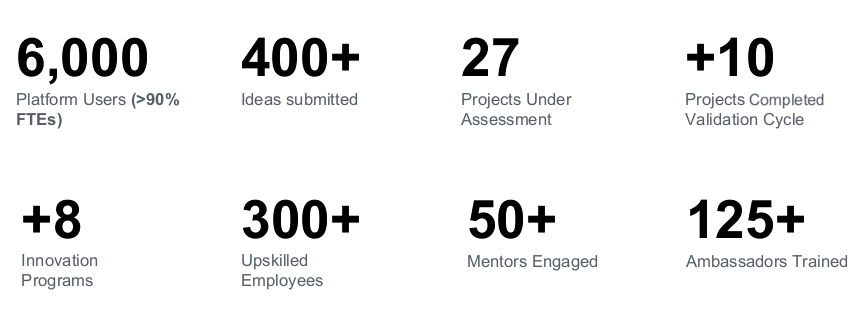
One Riyad Bank employee went from a senior manager to a senior vice president within a couple of years, jumping two levels in the hierarchy. Due to Faisal’s training, he now knows how to analyze a problem, develop a solution, pitch it to his seniors, gain support, and create the MVP. He adopted an entrepreneurial mindset and rose faster.
Faisal said, “If you want people to join the journey, they have to go through an unforgettable experience, something that changes their personality and their lives. If you come into this program, you come out a different person.”
The Ability to Gift a Personalized Visa Credit Card
An employee from customer support submitted an idea to let users load cash onto a credit card and gift it to someone, alongside items such as flowers, chocolates, or letters.

An Internal IT Management Solution
An IT employee felt they were using too many disconnected platforms to manage their work. This resulted in a lot of time switching between different tools and exporting data from one tool to another.
So, this employee submitted an idea to consolidate all Al Rajhi Bank’s internal IT management solutions into one bespoke platform, which led to big efficiency gains. This gave the IT team one place to handle everything from infrastructure oversight and security updates to workflow automation.
Advice for Organizations Looking to Promote Innovation and Overcome Bureaucracy: 3 Main Takeaways
1. Position Innovation as Something That Can Help Employees Achieve Their Career Goals
When communicating with employees, Faisal couldn’t position his messaging as if he were talking to a fellow innovation manager by saying he wants them to start innovating, collaborating, and co-creating. Frontline employees knew nothing about innovation management, and this wouldn’t help them understand what’s in it for them.
Instead, Faisal credits much of his success at Al Rajhi Bank and Riyad Bank to his understanding of employees’ motivations and to presenting innovation as a means to achieve those goals.
At Al Rajhi and Riyad Bank, Faisal knew that employees' motivations were to (1) move up in the organization and further their careers and (2) get things done without all the red tape in the usual corporate structure.
So, when engaging employees, he tailored this messaging around these two motivations:
He emphasized that if employees complete the training, they’ll start to think like entrepreneurs and innovators. They’ll have the skills to identify problems and opportunities they once overlooked and work on solutions. These skills can help them climb faster and give them exposure to company leaders.
He spoke about how the new innovation process will be a shortcut to getting things done, and leadership will see their ideas.
So, if you’re implementing innovation processes in your organization, Faisal recommends speaking with employees, learning about their motivations, and positioning innovation as something that can help.
2. Get a Team of Experienced Innovation Professionals on Your Side
Faisal pointed out that there are a lot of challenges that innovation managers face when implementing innovation processes in large organizations from scratch, such as:
Overcoming bureaucracy
Getting leadership buy-in
Engaging employees
Managing change
Analyzing data and reporting on progress
Developing innovation strategies
As a result, Faisal recommends that instead of trying to establish innovation processes on your own, you can increase your chances of success by getting a team of innovation professionals in your corner. This brings together a wider pool of innovation expertise, as well as an objective perspective from outside the organization that can spot blind spots you may be too close to see.
In fact, when Faisal was choosing an innovation management platform to host Al Rajhi Bank's and later Riyad Bank’s innovation processes, one of his main criteria was whether the platform also offered a team with decades of experience to support him, offer advice, and guide him through challenges.
This is a key reason why Faisal chose InnovationCast. Our experience at InnovationCast, as well as our prior 15 years as innovation consultants, enabled us to serve as his integrated innovation team at both Al Rajhi Bank and Riyad Bank.
3. Consider Your Organizational Context and Industry Regulations When Choosing an Innovation Platform
Faisal’s final piece of advice is to choose an innovation management platform tailored to your organization’s context and innovation strategy.
For example, Riyad Bank had various ideas that needed to be tested and implemented, each with different levels of risk and uncertainty. There were product ideas, continuous improvement ideas, business model ideas, process ideas, and more. Since testing and implementing these ideas require vastly different steps, he knew he needed a platform that could support multiple workflows.
Faisal chose InnovationCast because it allowed him to set up multiple workflows and configure them using advanced logic rules, conditional triggers, automated approvals, Metered Funding, and nearly any other setting (without any coding required).
Most innovation platforms don’t offer this. They have basic and rigid workflows (e.g., submit → review → approve/reject) and lean heavily toward idea capture and collaboration.
On the other hand, Faisal says that there are platforms that position themselves as a completely configurable innovation solution but don’t have a pre-existing platform from which to build, like InnovationCast does. So, they code the entire platform from scratch, which is very expensive. Faisal notes that many platforms in this research cost over SAR 2 million.
With InnovationCast, Faisal had the configurability that these custom-development firms offer at a more affordable price.
In addition, the Saudi Arabian government has a regulation requiring that all innovation data be stored on servers within Saudi Arabia, so Faisal needed a platform that could comply with this requirement. InnovationCast is the only innovation management platform he has found that can do this.
Implement a Fast and Nimble Innovation Process Within Your Organization Using InnovationCast
Schedule a 25-minute demo to see how InnovationCast can help you implement similar innovation processes within your organization.