
Much of the guidance on prioritizing ideas suggests using frameworks such as RICE, MoSCoW, or the Kano Model. With these frameworks, you rate ideas on a scale of 1 to 5 across multiple factors. The highest-scoring ideas get prioritized for implementation. Prioritization frameworks work well for ideas when you have the data to work with.
More often than not the issue isn’t getting ideas from employees or stakeholders, it’s knowing what to do with them next. How you organize and prioritize them will significantly shape which ideas make it across the finish line and which get buried.
But prioritization frameworks fall short when applied to ideas with high uncertainty. For these ideas, there is no data that you can look back on because they create something new or radically change how things are done. For example, introducing an entirely new product category, adopting a new technology, or changing your business model.
We’ve developed this practical approach to help companies prioritize both types of ideas, drawing on our 15+ years of experience as innovation professionals.
But before we get into that advice, it's important to note that successful innovation management starts with clear, established processes. And when those processes need to operate at scale, automated workflows become essential for handling the heavy lifting and guiding next steps. Without them, innovation management teams face:
Backlogs where ideas pile up waiting for manual review and routing.
Lack of clarity about what has happened so far and what should happen next with each idea.
Lost momentum as employees submitted ideas, but never heard back about their status.
Inconsistent evaluation in which similar ideas are treated differently depending on who reviews them.
Wasted time on administrative tasks (such as sending emails and reminders) instead of high-value tasks, such as helping people to improve their ideas.
If you set appropriate innovation processes you will:
Move ideas systematically from submission through evaluation, validation, and implementation.
Ensure nothing falls through the cracks by automating notifications and next-step triggers.
Maintain transparency so that idea authors and all stakeholders always know an idea's status.
Scale your innovation capacity without proportionally scaling your team size.
Free up innovation managers from manual coordination work that can be fully automated and work on high value activities such as helping teams develop ideas and strategic decision-making
We’ll explain how InnovationCast supports the management and prioritization of ideas at scale.
How to Prioritize Low-Risk, High-Certainty Ideas
Low-risk, high-certainty ideas are when you have the data and a good sense of what success looks like. You’re 95% certain of the outcome from the outset. And if it doesn’t work out, there’s no real harm done.
For example, a healthcare clinic may notice that 30% of patients abandon the online scheduling form before completing it. Simplifying the form would likely increase the number of completed bookings. Similarly, if the clinic sees a 150% increase in complaints about long wait times during peak hours, scheduling more staff during those periods would likely reduce wait times and the number of complaints.
Prioritizing these ideas is straightforward. Evaluators score each data-backed idea using a prioritization framework or template. Because the inputs are quantifiable, such as time to impact and outcome potential, the ideas can be ranked algorithmically, producing an objective implementation order that can then be overridden.
Without any context, we can’t tell you exactly which criteria to prioritize (no one can). The framework you choose and the criteria you include are highly contextual to your organization. It depends on your company’s strategic direction, product strategy, growth appetite, risk tolerance, and a host of other factors.
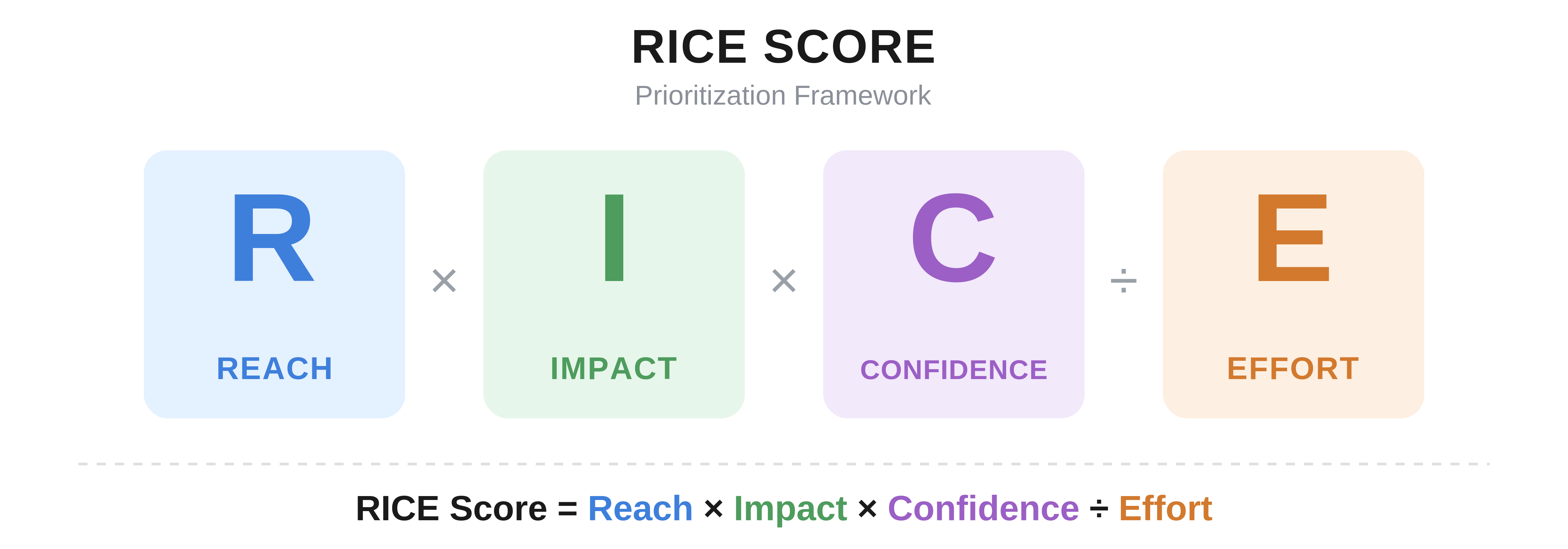
If you are just getting started, you can pick a simple prioritization framework such as RICE that we see working well across industries:
How many people do you think this idea will reach?
What impact do you think this idea will have on the company?
How confident are you that the idea will work?
What effort will be required to implement this idea?
To calculate the final RICE score, multiply the reach, impact, and confidence scores and divide by the effort score.
 Here are some other frameworks you can adapt to your needs:
Impact/Effort Matrix: This framework is a good option when you need to move fast. It uses four quadrants to prioritize ideas based on impact and effort. It advises starting with high-impact, low-effort ideas first, then high-impact, high-effort ideas. If you have spare capacity, implement low-impact, low-effort ideas and avoid low-impact, high-effort ideas.
Weighted Scoring System: This flexible prioritization method encourages you to select criteria based on what matters most to your company (e.g., alignment, potential value, cost). Then you assign relative weights to each priority item and evaluate the idea against each. Multiply each score by its corresponding weight and sum the results.
Read more: 6 Steps to Creating a Culture of Continuous Improvement Within an Organization
Read more: 6 Steps to Creating a Culture of Continuous Improvement Within an Organization
How to Prioritize High-Risk, High-Uncertainty Ideas
The frameworks listed above are effective at prioritizing high-certainty ideas where you already have data and evidence supporting their impact, demand, feasibility, or profitability.
However, you cannot use a simplistic prioritization framework to score ideas when you don’t have the data. They may have the potential to drive value for the company, but there’s no way to know in advance, just analytically, if they will work.
For example, take a fitness studio chain that operates on a traditional membership model. An idea to pivot to a pay-per-class marketplace connecting independent instructors with customers would be high-uncertainty for a couple of reasons.
Customers may prefer the stability of unlimited memberships, or instructors might prefer employment over contract work. Financial modeling can't capture whether the network effects will materialize, how pricing dynamics will settle, or if brand loyalty will survive the structural change. However, if the idea proves successful, it could scale rapidly without the capital constraints associated with opening physical locations.
To prioritize higher-risk, higher-uncertainty ideas, we advise companies to work iteratively to gain knowledge that reduces uncertainty around the idea and to use those insights to inform their investments.
Read more: 3 Key Factors for Managing Innovation Projects at Scale: People, Process, Platform
Step 1: From a Discovery Team to Test the Idea
The innovation department should assemble a discovery team to reduce uncertainty in the idea to a level where top management or sponsors are confident they can make a funding decision.
You should assign a cross-functional discovery team to each high-uncertainty idea that needs to be validated. The team's composition should depend on the nature of the idea—for example, it might include an engineer, a designer, and a marketer.
Step 2: Map Assumptions
Discovery teams, in partnership with top management, sponsors, and other decision-makers, will map assumptions, which are the conditions that must be true for the idea to be successful and deliver value for the company. This typically relates to customer needs, functionality, demand, ability to make it work, and alignment with the organization’s strategic goals.
Staying with the fitness studio example above, assumptions may include:
Customer-side assumptions:
Variety and choice - Customers value class variety and instructor choice more than the predictability of unlimited memberships.
Flexibility justifies the cost - The convenience of flexible scheduling outweighs the higher per-class cost compared to memberships
Quality speaks for itself - Customers will trust instructor quality without the studio's brand vetting every class.
Demand supports supply - There's enough demand density to fill classes consistently.
Instructor-side assumptions:
Flexibility over stability - Quality instructors prefer earning potential and flexibility over employment stability and benefits.
Discoverable - Instructors can market themselves effectively, or the platform provides enough visibility to attract clients.
Supply meets demand - Enough quality instructors exist in target markets to create a compelling choice for customers.
Platform stays in the loop - Instructors won't simply poach customers and bypass the platform.
Business model assumptions:
Works from the start - The marketplace delivers real value within smaller markets. It doesn’t need many users to work.
Sustainable - As the marketplace grows, fees cover customer acquisition, tech, and operations.
Stands out from the crowd - The marketplace can differentiate enough to prevent commoditization and price wars.
Brand’s reputation is an asset - Customers already trust the brand, and that trust transfers to the new model rather than being destroyed by the change.
Market assumptions:
The regulatory path is straightforward - Instructors can be classified as independent contractors without regulatory challenges.
First-move advantage - Competitors will find it difficult to replicate the model quickly enough to close the gap.
Acquiring both sides is affordable - The cost of attracting both customers and instructors is financially viable.
Without experimentation, such as launching a pilot marketplace in one city to test different pricing models, these assumptions remain unvalidated hypotheses. Only real-world testing can reveal whether this business model transformation will be successful or not.
Step 3: Run Experiments to Validate Assumptions
Management should allocate a small budget for discovery teams to run experiments testing the highest uncertainty assumptions that, if untrue, will immediately terminate the entire project.
Let’s say that this is one of the “make-or-break” assumptions for the fitness studio:
Network effects kick in at achievable user thresholds. If the marketplace requires too many instructors and customers to be valuable, the company will face a chicken-and-egg problem that's impossible to solve without massive capital.
Unlike the membership model, where one location can be profitable independently, a marketplace that doesn't reach critical mass in each market will fail entirely. The team should develop an experiment to test it:
Launch a minimum viable marketplace (MVM): Start in one neighborhood/zip code and aim for 5-10 instructors and 50-100 customers.
Track the "liquidity threshold": At what number of instructors and customers do they see repeat bookings, rising fill rates, and organic growth?
Track metrics that could indicate success: booking frequency, customer retention after 30/60/90 days, and instructor allocation rates.
Model what would be the minimum density needed: For example, "10 instructors offering 40 weekly classes with 60% average fill rate", to create a sustainable flywheel.
After the experiment, the management and discovery teams review the results together and assess whether the assumptions are valid or invalid.
If the assumption holds, management releases another round of funding to test the next highest-risk assumptions. If the assumption doesn’t hold, teams can either pivot to explore alternative ways of making the idea work or terminate the project. You should prioritize projects that can validate assumptions.
We recommend this milestone-based funding approach, rather than funding all experiments at once, because priorities will evolve as discovery teams gain a deeper understanding of an idea. An idea may seem promising at first, but teams can encounter unexpected roadblocks a few months into the discovery phase, which is when other ideas start to take priority.
If early results are positive, the idea moves up in priority and gets more resources. If not, you can end the project without taking a substantial financial hit.
Once assumptions have been made, validated, and uncertainty reduced to an acceptable level, product management teams take over to implement the innovations, starting with the highest-priority ones.
Read more: Idea Validation: A Guide to Affordably Testing Ideas
How InnovationCast’s Workflows Support the Prioritization of Ideas at Scale
We designed InnovationCast with powerful innovation processes (also known as workflow engines) that guide evaluators and discovery teams on how to prioritize and test different kinds of ideas.
We found that such guidance is necessary because most of the time, people on the discovery team are doing the work for the first time. They aren’t innovation professionals, so they probably don’t know the best and most efficient ways to identify risk factors, map assumptions, design experiments, or pivot based on lessons learned. This structure sets the team up for success and elevates the discovery team's skills, thereby increasing the organization's innovation capability.
We have workflows tailored to continuous improvement, business model, new product, technological, and other common types of ideas.
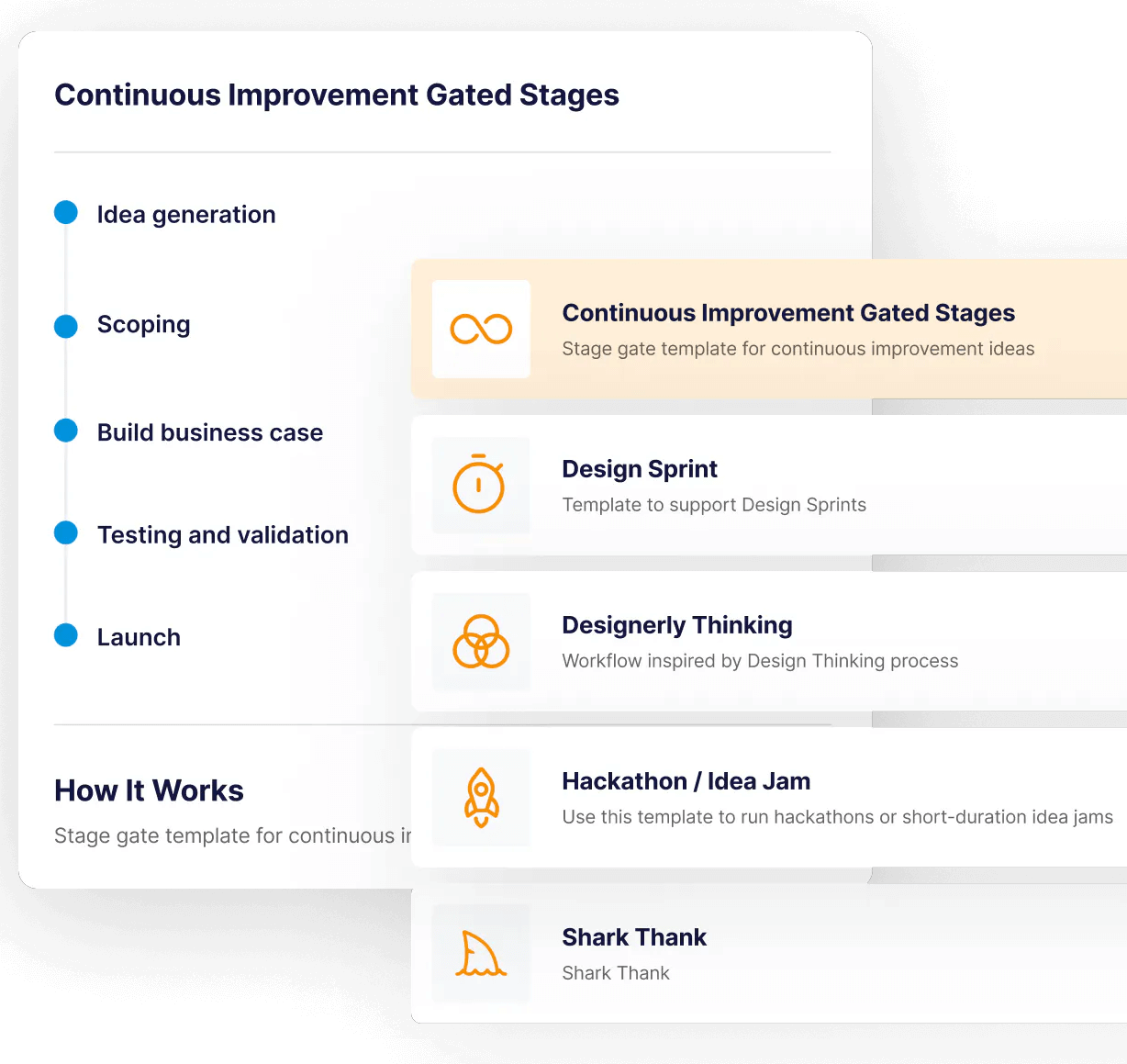
We work with you to customize these workflows around your strategic direction and specific needs. However, you can easily edit them by removing, adding, or rearranging important tasks within the workflow. No coding or product development required.
Essentially, you have the same level of flexibility as if you had built the software in-house. If you need a product feature that we don’t currently offer, we can add it to our product roadmap and deliver it to you as soon as possible.
This is a common weakness among many innovation management platforms. They only come with a single prioritization process that offers limited configurability, and you have to push all ideas through it.
This is how InnovationCast supports idea prioritization and validation:
It structures the work to be done after ideas are collected, ensuring they are developed into innovative solutions.
It automatically notifies relevant team members when their input is required (e.g., evaluators, discovery or product teams, stakeholders). This streamlines work and prevents the project from stalling. InnovationCast can even be configured to automatically release the next round of funding once assumptions are valid.
It automates the repetitive work of prioritizing ideas at scale, such as emailing idea authors when their idea is chosen or when the evaluator requires more information. Relying on emails, spreadsheets, and other ad hoc tools to manage ideas requires a lot of manual work and is difficult to scale.
Management can gain a complete, up-to-date view of the innovation portfolio on the InnovationCast dashboard. They can see which ideas are performing well and redirect resources to the most promising ideas.
Final Tip: Communicate Prioritization Criteria to Innovation Participants When Collecting Ideas
A lot of companies that we talk to struggle with selecting and prioritizing ideas because:
Ideas don’t meet their prioritization criteria.
Ideas don’t contain the data or evidence needed to score them.
This happens when companies ask for ideas without explaining what they are looking for, i.e., the criteria for selecting and prioritizing ideas. This leads authors to submit ideas that don’t align with the criteria or lack sufficient evidence to score in the first place.
It’s essential to be specific when asking people to submit ideas, whether through an Innovation Challenge or Hackathon, what criteria you’re prioritizing. That way, employees and stakeholders can focus their brainstorming on those initiatives and add as much information to their ideas as possible, so it’s easier to score.
Important note: In most companies, the number one product prioritization factor is cost, even if it’s not explicitly stated. That’s because it’s easier and lower risk to pick ideas that require fewer resources. Having a cost bias is okay, as long as you let people know. If innovation participants know that’s part of the criteria, then they can work on reducing the cost of trying.
Informing innovation participants that the cost of trying is one of the criteria guides them to submit low-cost, testable ideas with ample evidence explaining why their idea is cost-effective, increasing the likelihood it will be prioritized. This leads to faster iteration cycles and more innovation.
Read more: 6 Steps to Crowdsourcing Innovation Within an Organization
How InnovationCast Facilitates Productive Idea Generation
We have added an Innovation Challenges feature to InnovationCast. This allows you to create comprehensive postings containing all the details innovation participants need to review before submitting their ideas, including prioritization criteria. We can even create these postings for you so you don’t have to start from scratch.

Once you launch a challenge, all innovation participants receive an email prompting them to review the challenge information and submit their ideas.
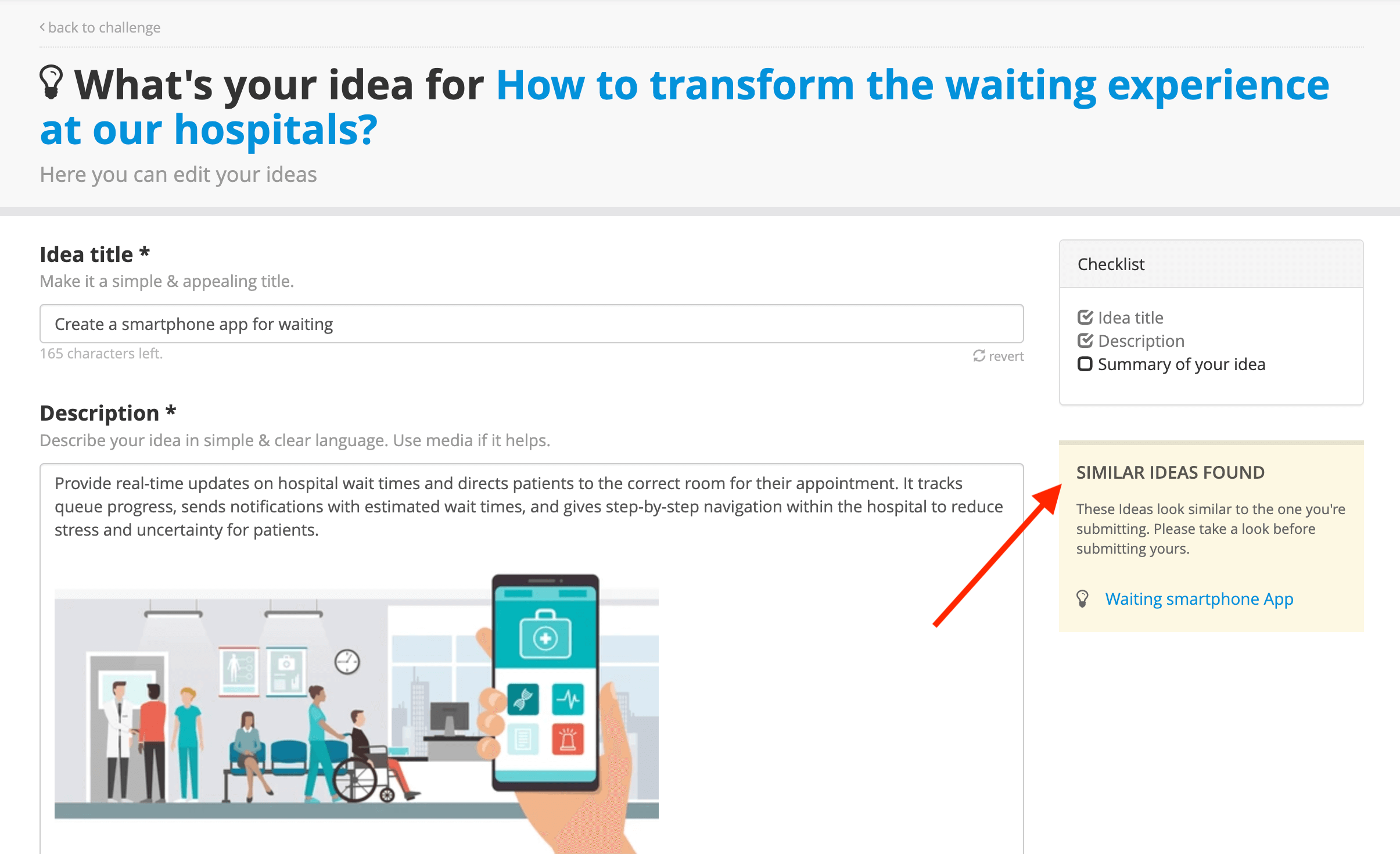
InnovationCast also comes with supporting features, such as a duplicate checker. This detects when someone is about to submit a similar idea that has already been submitted and asks them to collaborate with the original contributor rather than share the duplicate. This prevents evaluators from repeatedly filtering through the same ideas.
Implement a Productive System for Prioritizing Ideas At Scale Using InnovationCast
Talk to our team to learn more about how InnovationCast can support your business goals and innovation initiatives.