

Innovation benefits not only businesses but society as a whole. In this article, we explore the concept of human-centered innovation - what it is, its benefits, best practices and methodologies we've found most effective, and common pitfalls to avoid.
We’ll share how we built InnovationCast, our innovation platform, to engage employees and other relevant innovation participants in ideation and, most importantly, to turn ideas into innovative solutions that deliver return on investment and real impact.
What Is Human-Centered Innovation?
Human-centered innovation is essentially putting the customer at the core of your innovation processes and building solutions around them. It’s an innovation methodology that focuses on gaining a deep understanding of their needs, motivations, and pain points, then building outcomes they will actually benefit from.
The main benefit of adopting human-centered innovation is that you’re more likely to develop innovations that resonate with real people.
Human-centered innovation can be contrasted with technology-centered innovation. This is when the innovation and design process comes first, and the problem to be solved comes second.
That’s not to say that technology-centered innovation is wrong, it’s simply another way of innovating. Many technologies that exist today, such as smartphones, microwaves, generative AI, and cars, wouldn’t have been possible without technology-centered innovation. At the time, customers weren’t asking for these breakthrough innovations as they were unaware that they could be developed.
However, engineers and scientists sometimes become so focused on technology breakthroughs that they fail to step outside their labs and engage with customers, ultimately delivering innovations that produce little long-term success.
Steps to Implement Human-centered Innovation at an Organizational Level
When we take a human-centric approach to innovation, we follow a creative process known as Design Thinking. This process will give you a step-by-step guide to understanding your customers and delivering the right solutions.
Design Thinking comprises five steps:
Empathize: Gaining a deeper understanding of the people you are designing products for. This usually involves observation in context, co-creation, rapid prototyping, and iterative user experience testing.
Define: Apply what you learned in the empathize step to define the customers’ needs and pain points.
Ideate: Brainstorm and generate ideas for products, services, and improvements that address the human needs and pain points identified in step two.
Prototype: Developers build a prototype of the idea as quickly and as affordably as possible. At this stage, the goal isn’t to create polished or fully functional applications, but to produce simple, low-fidelity prototypes that customers can interact with.
Test: The final step in Design Thinking is iterative. Rather than marking the end, it loops teams back to the Empathize stage. Teams gather customer feedback on the prototype, brainstorm new ideas, and test improved solutions.
Here’s how we use Design Thinking principles to implement and generate value from human-created innovation at an organizational level.
Establish a Design Thinking Mindset Among Employees
We advise innovation managers to cultivate a Design Thinking mindset throughout the entire workforce.
This way, all customer-facing employees (e.g., customer success, support, sales, marketing) utilize their knowledge about customer needs and pain points to brainstorm solutions. Companies tap into the perspectives and problem-solving of all customer-facing teams, potentially uncovering problems they didn’t know existed. When multiple teams are using Design Thinking, the quality of ideas tends to be higher.
A great way to cultivate Design Thinking in employees' mindsets is with Innovation Challenges.
An Innovation Challenge is a focused call for ideas on specific priorities, with context to guide employees thinking.
In challenges with a human-centered approach, this often means asking employees to empathize with customers, surface pain points they found, and share suitable solutions.
What makes Innovation Challenges particularly effective is the ability to set specific requirements that idea authors must meet for their ideas to be considered for testing and implementation. For example, you could ask that ideas be supported by at least three customer interviews or relevant survey data, ensuring their ideas are “people first.”
Read more: 5 Detailed Innovation Challenge Examples & Best Practices
You Can Crowdsource Ideas Rooted in Customer Needs Using InnovationCast Challenges
We developed our innovation management software with an Innovation Challenge feature to engage employees in brainstorming innovative ideas aligned with Design Thinking principles.
We create these challenges for you during onboarding, tailored to your priorities and innovation strategy. We’ll also take care of launching them, onboarding team members, and ensuring participation across departments.
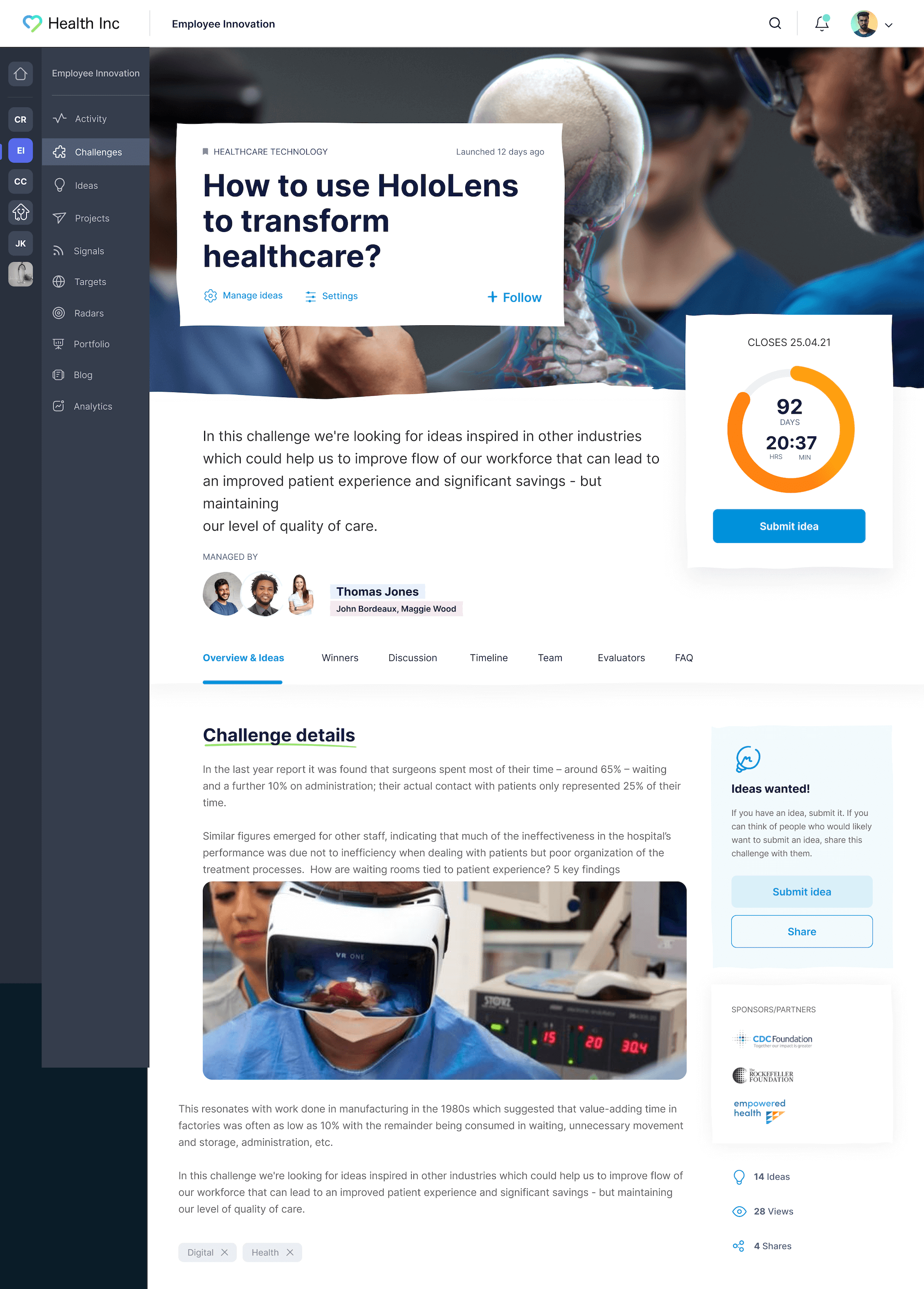
Upon launching a challenge, employees are notified that their input is needed. They can browse the challenge context, begin interviewing or surveying customers, and share pain points and ideas. All challenges come with deadlines, which encourage employees to schedule interviews and submit ideas quickly to drive innovation.
Another factor that sets InnovationCast challenges apart from other platforms is that users can track the progress of their ideas. They can see if their ideas are in the refinement, prototype, testing, or improvement stages.
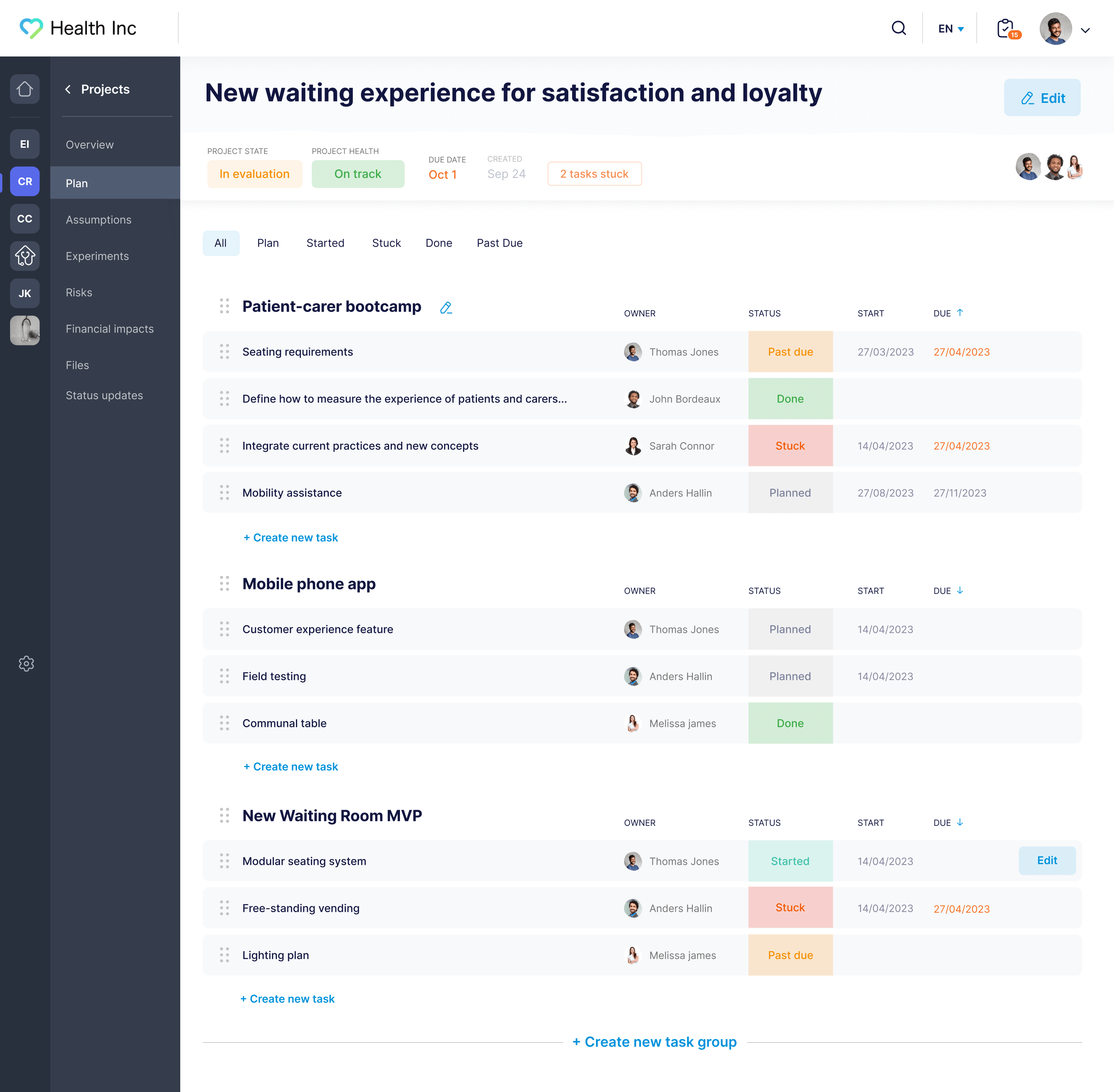
This signals to employees that the company is investing time and resources into their ideas, and that all the effort they put into connecting with customers, empathizing, and brainstorming wasn’t for nothing. Providing this transparency is needed to engage employees long-term.
Enable Employees to Work Together and Refine Each Other’s Ideas
A step that’s not formally part of the traditional Design Thinking model, but one we incorporate into innovation processes, is idea refinement.
Idea refinement means getting multiple competencies and different customer segments to review and improve ideas once they’ve been submitted.
This step is important for grand, high-impact ideas, where multiple competencies are required before they can be validated and implemented. For example, engineers may need to assess the technical feasibility of new product ideas, while finance teams may need to consider cost implications. One idea author doesn't have the expertise in all these fields to think through each consideration.
Idea refinement helps bring these viewpoints together and transform raw concepts into well-rounded proposals.
To facilitate idea refinement, we recommend creating a workspace where employees can see ideas submitted by their colleagues and use their skill sets to find weaknesses and refine them.
However, because of how most companies collect ideas, this isn’t possible. Each department collects ideas using its own tools, and other departments or customers can’t view those ideas and co-create.
To address this, we placed greater emphasis on collaboration and co-creation in designing InnovationCast.
The InnovationCast Feed Displays All Ideas and Gently Promotes Users to Improve Them
When an employee or perhaps even a customer shares an idea, it goes to the InnovationCast news feed.
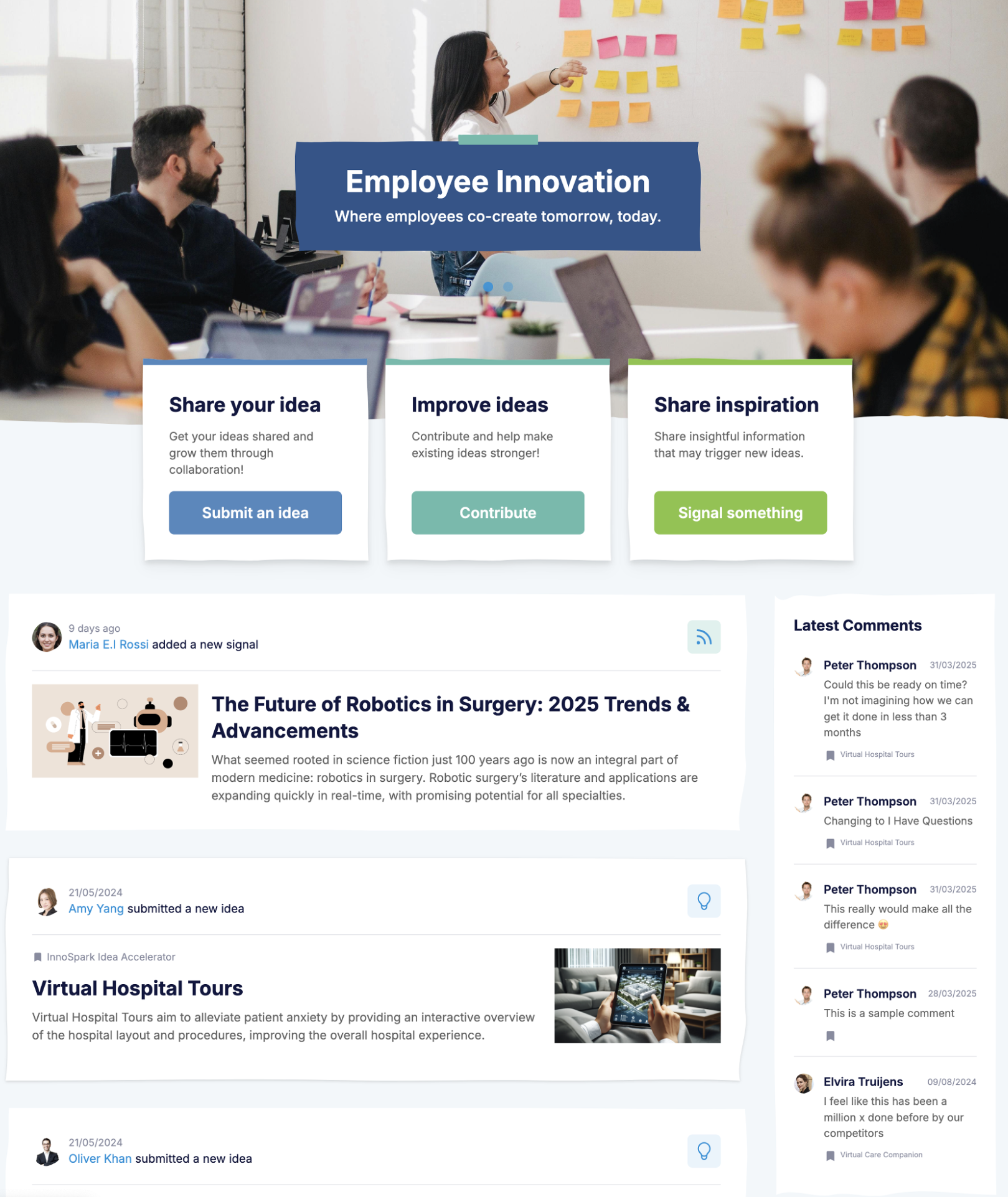
Relevant users, including other employees and customers, can view the idea. Then, they can vote, provide feedback, or additional perspectives that the idea author may have overlooked, and co-create to improve the idea.
As idea authors and co-creators collaborate, InnovationCast saves each version of the idea, acting as a version history in case stakeholders want to revert or see how the idea evolved over time.
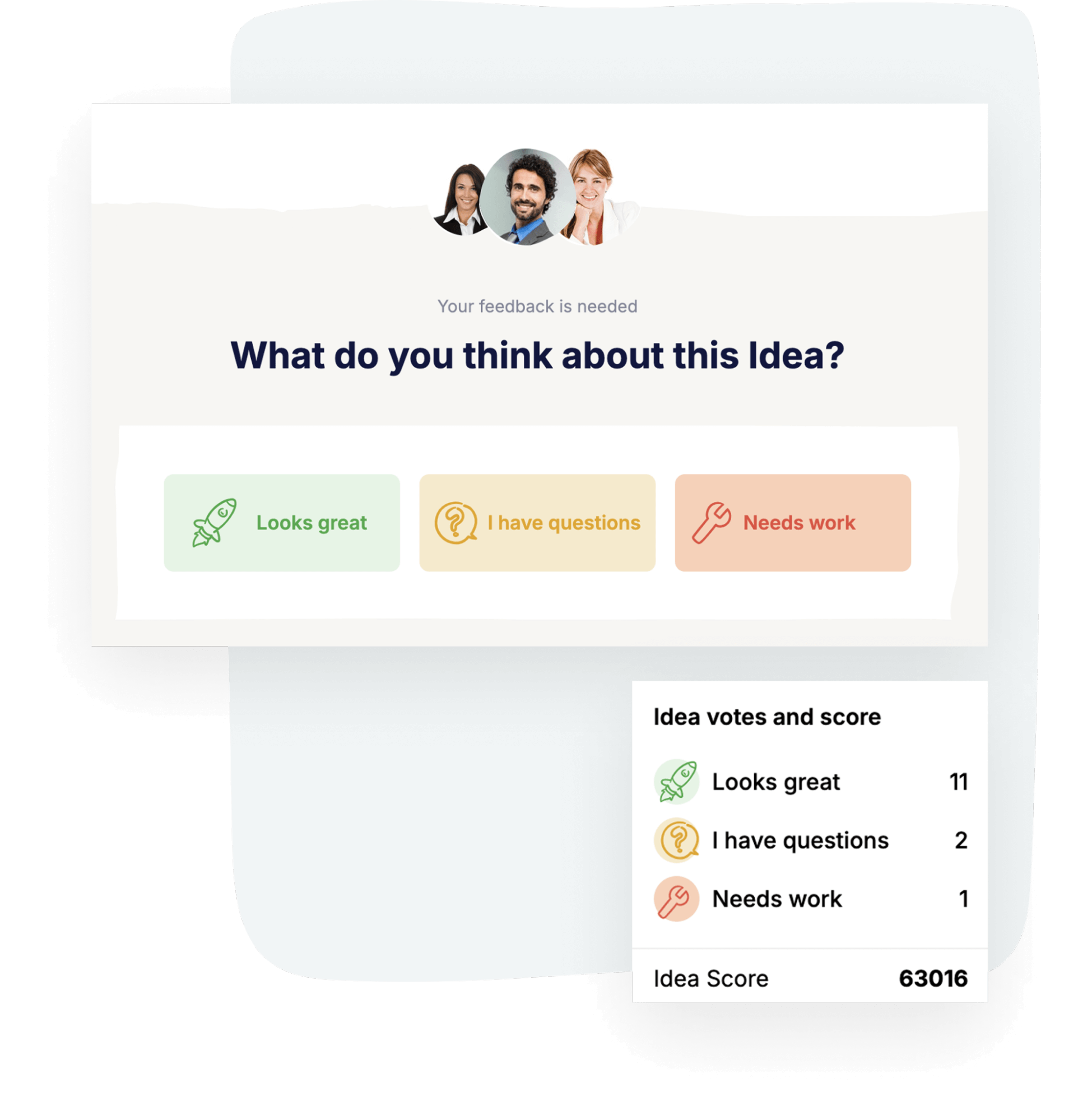
We also added subtle features to encourage engagement among employees. For instance, if a piece of feedback had a profound impact on shaping an idea, the idea author can use the Significant Contribution tag, which highlights the comment and puts it at the top of the thread.
This does three things:
It rewards employees for high-quality participation using public recognition.
It indicates to the rest of the community that feedback is valuable, encouraging them to get involved.
Stakeholders can quickly see the feedback that improved the idea, so they don’t have to read through all the comments.
Read more: How to Implement a Customer Co-Creation Process: Step-by-Step Guide
Build a Prototype and Test Its Validity
Upon designing a concept, Design Thinking says teams must build a prototype as quickly and as cheaply as possible, release it to customers, and collect feedback.
Design Thinking offers considerable flexibility at this stage. There are no requirements about the types of testing beyond prototyping, who is responsible for testing, or how to measure and interpret results. For this step, we’ll share what we’ve learned from experience.
When managing human-centric innovation at scale, it’s important to establish automated workflows that define what should happen after ideas are collected. This includes determining who should be involved, their responsibilities, deadlines, and the assumptions or hypotheses that must be validated before moving to implementation.
This is critical because it ensures that companies don’t just collect ideas but actually turn them into successful innovations. That’s what generates ROI and secures more budget down the line.
Too often, innovation projects stall after the refinement stage because no one knows what’s needed to test and implement an idea. This means that top management sees investment flowing into business innovation without any returns, leading them to cut funding.
We design InnovationCast with comprehensive workflows to help companies generate ROI from innovation.
InnovationCast Workflows Provide Structure and Guidance for Testing Ideas
InnovationCast workflows serve as guides that outline how teams should test various types of ideas. We created them using our 15+ years of innovation management experience.
Our workflows contain all the tasks that must be completed to validate an idea. For each task, it details the person who needs to do it, what information they need to consider, and any other relevant requirements or inputs.
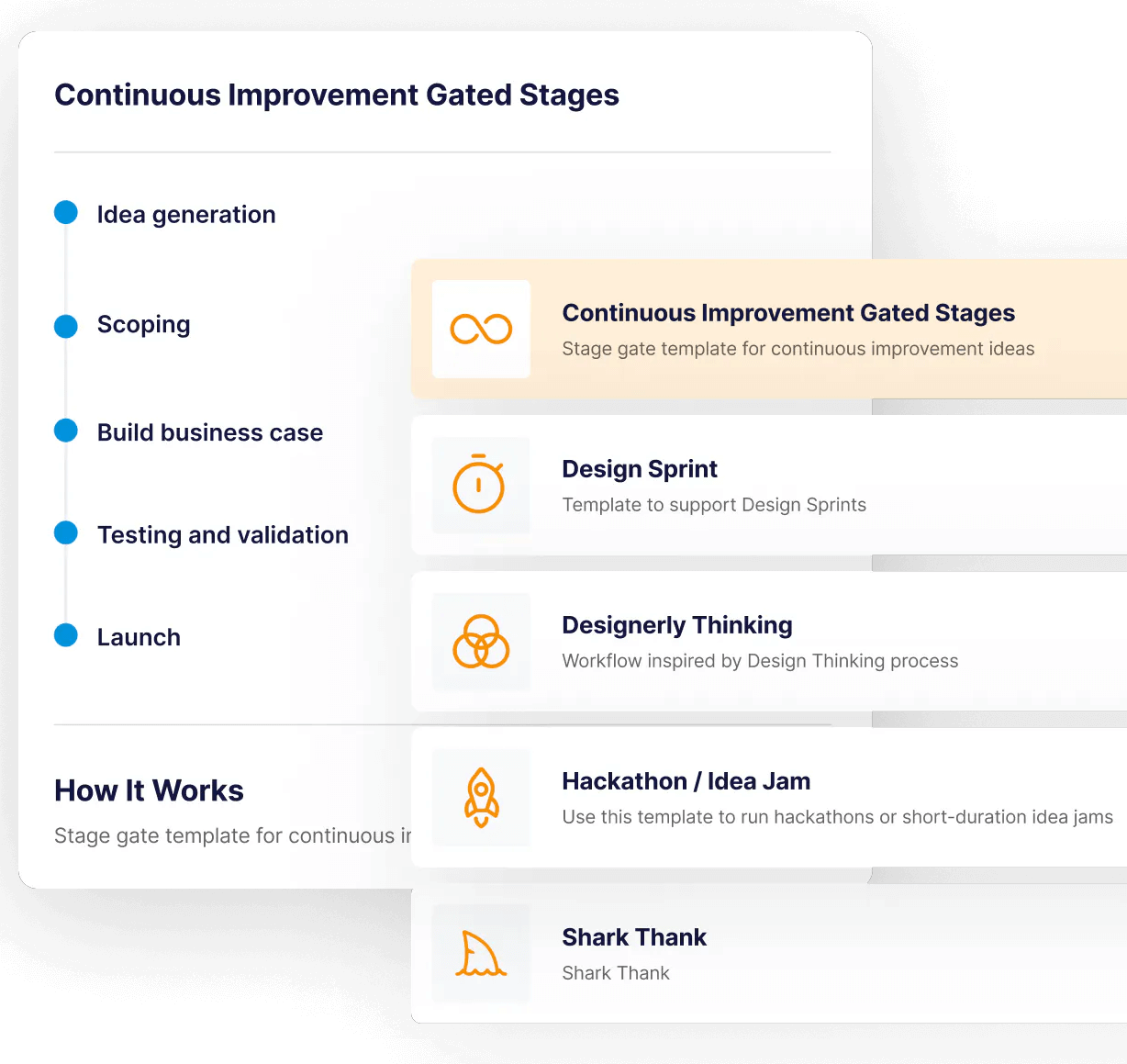
For example, once a new product idea is submitted and refined, InnovationCast might ask to involve the marketing team to create a fake-door landing page to test demand, then engage the finance department for cost analysis, bring in a developer to sketch a prototype, and finally coordinate customer interviews to gather feedback and improve the design.
Our workflows with built-in automation features ensure everyone working on business innovation knows what they need to do to test and de-risk an idea, without an innovation manager having to oversee every single project.
InnovationCast also has multiple types of workflows tailored to the unique risk profile and requirements of different ideas. We have workflows for new products, services, business models, internal processes, continuous improvements, and more.
These workflows are easily customizable. You can modify tasks and logic rules without touching code.
Gather More Customer Feedback and Continuously Improve the Initial Human-centered Design
The final aspect of Design Thinking and human-centered innovation as a whole is the principle of continuous improvement.
Once the prototype is in front of customers, companies should gather feedback on what they like and what they believe should be improved. Then, they should go back to the empathize and define stage: defining patterns in customers’ feedback, brainstorming solutions, testing them, and repeating the process.
Continuous improvement extends beyond the prototyping stage and also applies once ideas are fully implemented.
So, if companies test a new product, teams should interview customers to find any issues they encounter when using the prototype, then iterate upon it to improve user satisfaction.
Or, if companies make an improvement to an existing product, teams should learn what customers think about the change. If it’s actually better than the previous version, how can they make it better, or is it impractical and they are better off reverting?
To continuously improve human-centered design, companies need systems in place to track progress and measure the ROI of innovation. Then, all that information must be aggregated in one place so top management can see where their budget is going. It also helps innovators understand the effectiveness of their innovations and pivot where necessary.
When top management lacks a simple way to track the progress and outcomes of innovation projects and has to switch between multiple tools, they might struggle to see the ROI and may cut funding.
Read more: 6 Best Innovation Portfolio Management Software in 2025
InnovationCast Aggregates Information and Learnings From All Innovation Projects Inside One Reporting Dashboard
As teams build prototypes and test their ideas, all their learnings are automatically pulled into the InnovationCast reporting dashboard, so top management and sponsors can easily see the results their budget is generating.
They can view all projects, the amount of budget dedicated to them, and the results they’re generating (e.g., sales, customer adoption, or validated learnings, efficiency gains).
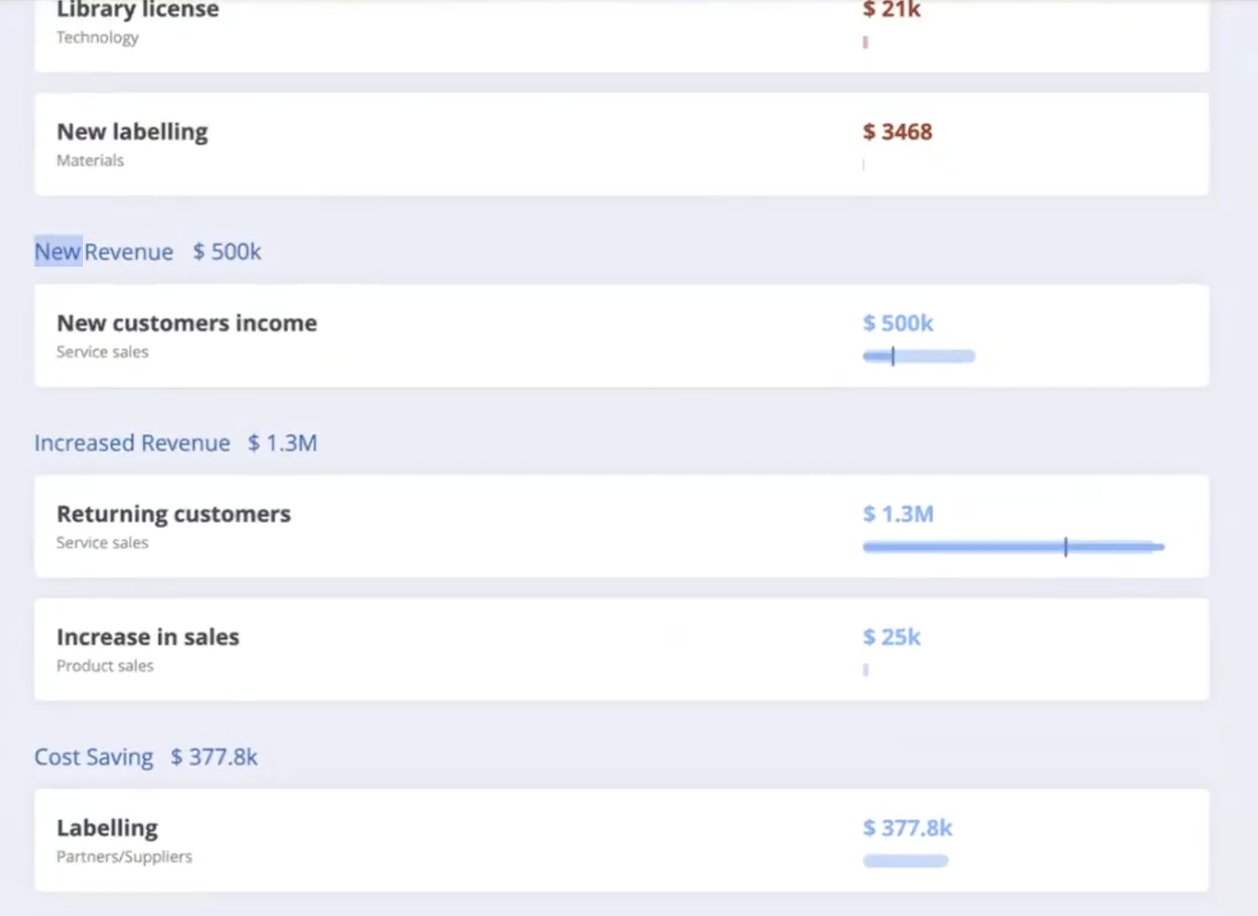
The InnovationCast reporting dashboard can integrate with almost any data visualization tool, including Google Analytics, Google Charts, Microsoft Power BI, and Tableau. Top management doesn’t have to switch multiple dashboards to see the progress each team is making.
Read more: 10 Best Practices for Fostering a Culture of Innovation
Implement a Human-centered Innovation Process within Your Organization Using InnovationCast
Book a live 25-minute demo to see how InnovationCast can help bring human-centric innovation to life in your company.