


Innovation portfolio management is where most innovation programs are weakest. It's what links innovation to company goals and shows whether you're delivering on your innovation strategy, so you know where to focus and when to change course. Without it, any value you get from innovation is an accident you can't repeat.
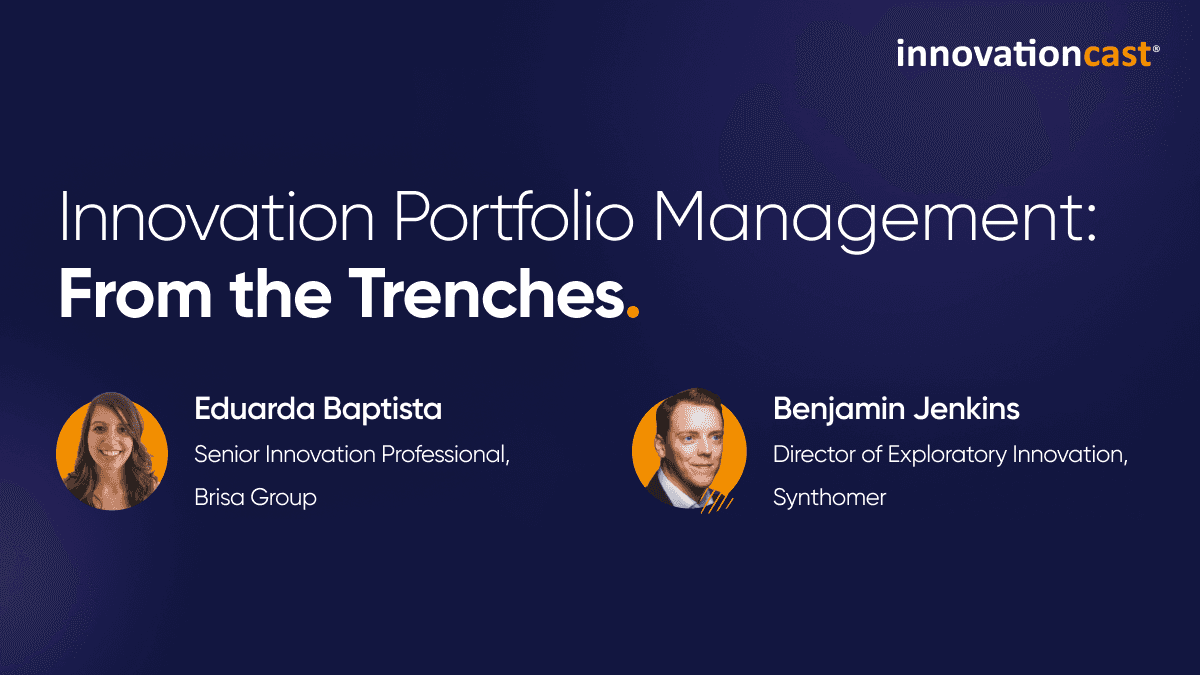
InnovationCast recently hosted Innovation Portfolio Management: From the Trenches, a live conversation between two innovation leaders from very different industries. Eduarda Baptista, Senior Innovation Professional at Brisa Group, manages an innovation portfolio spanning highway operations, electronic tolling, service areas and car inspections. Benjamin Jenkins, Director of Exploratory Innovation at Synthomer, leads front-end innovation at a specialty chemicals company.
They talked about specific decisions and projects, including the ones that didn't work out.
1. Bring innovation out into the open
Eduarda and Benjamin both stepped into newly created roles, and a big part of each job is making the innovation portfolio visible.
At Brisa Group, that meant pulling together a wide spread of businesses, from highways and the Via Verde tolling system to Controlauto car inspections and Brisa's tech arm, A-to-Be. Eduarda's team was created to give leadership one view of innovation across all of them, with shared guidelines and a common process.
At Synthomer, the portfolio runs from early market signals and customer requests all the way to commercial deployment, with stage gates along the way. When business units want to run their own projects, Benjamin's answer is visibility:
“All innovation sits on one platform, and any idea asking for R&D resources has to meet clear criteria. So there's no stealth, nothing hidden."
2. Take the next small step
Benjamin summed up innovation portfolio management simply:
"In practice, for me, it comes down to deciding what deserves our next big commitment."
That commitment might be someone's time, access to support or a bigger investment. He says the hardest part is deciding how much to commit while things are still uncertain. His answer is to bring every project back to the next important questions:
"What do we need to learn before we commit more? What's the next smallest useful test?"
And just as important:
“What will you do with the answer?
At the front end, that means measuring progress differently. Early on, the question is whether the customer need is clearer and the right assumptions are being tested. Stronger commercial evidence is expected as projects mature.
3. Move from activity to value
An ongoing challenge for Brisa Group is measuring value across very different project types. Many projects improve efficiency or safety rather than revenue, but how do you value a project that keeps employees in a risky roadside position for three fewer minutes?
Eduarda says her team uses a framework of input, process, output and outcome KPIs. In the first years they tracked activity, such as the number of projects and pilots. Now they're shifting toward output and outcome KPIs and asking for stronger business cases at the planning stage.
Synthomer frames success around two ideas. Efficiency is how well ideas and evidence turn into decisions and progress, measured by time between stages and whether evidence actually led to a decision. Sufficiency is whether there are enough credible opportunities to support the company's growth ambitions.
4. Follow the evidence
Both speakers shared times when the evidence changed their minds, and neither found it easy.
"As a person who works in innovation, I tend to be optimistic, and I have to be persistent. So it's really hard for us to kill projects." — Eduarda Baptista, Brisa Group
At Brisa Group, the first winner of the internal innovation program came with a guarantee that it would be implemented: a robotic tree using micro-algae to capture CO₂, inspired by a startup the team saw in Mexico. It fit the sustainability strategy well. But after more than a year, there was no trusted partner and no proven concept to justify the investment.
"That one cost a lot to kill," Eduarda said.
It was harder because the idea came from employees. Still, stopping isn't always forever: she keeps her own "box of killed projects" and revisits them when she sees signals in the market.
At Synthomer, the hardest decision was reducing the portfolio by around 60%. The driver was evidence about commercial opportunity. As Benjamin put it, the projects were sensible with the information available at the time. But a portfolio has to change as the evidence changes. Fewer projects with a stronger focus meant more value, and explaining the reasoning clearly helped people accept it.
5. Invest in people as much as tools
Tools help, but both Eduarda and Benjamin kept coming back to people, and both are still working on how to measure engagement and culture. Participation is a start, but Benjamin wants to see more, such as whether colleagues are building on each other's ideas, collaborating across business units and sharing failed experiments. Eduarda described her team's long-term goal as making itself unnecessary, so people innovate on their own.
There's progress to show. Brisa Group moved its innovation portfolio out of Excel and onto InnovationCast, so every employee can see projects live and join in. Synthomer has grown longer-term innovation from under 1% of its portfolio to around 10%, supported by a monthly portfolio forum where idea owners get feedback and leave with clear next steps.
6. Connect the portfolio to strategy and the business
Asked whether the portfolio drives strategy or follows it, they gave the same answer: it does both.
Brisa Group works within four pillars (road safety, sustainability, customer engagement and urban mobility), while staying open to ideas from the ecosystem and employees. Benjamin suggested splitting the portfolio into attack and defend: in new markets the portfolio drives decisions, while in core markets strategy steers the portfolio.
On handover, the two agreed on one thing: involve business units early. At Synthomer, R&D's job ends when there's a specification that can be replicated and manufactured. At Brisa Group, business specialists join from the planning stage so they're ready and funded to take a project to market.
Their advice for teams starting out
We asked both what they'd tell someone just starting out. Their advice covered two sides of the job: keeping the portfolio healthy, and bringing people with you.
"Something I wish I'd done earlier is to focus more on efficiency and sufficiency, and manage them both together. So progress ideas with discipline and make sure they're moving forward, and ensure there are enough credible opportunities to support future growth ambitions."
— Benjamin Jenkins, Synthomer
"We're managing not just projects but people as well. It's not about having this great tool. We have to have a really good governance model in place: make sure people know how to use it, get people involved, and focus on having a centralized view of a global innovation portfolio, not just individual projects. The governance model makes all the difference."
— Eduarda Baptista, Brisa Group
Watch the full conversation
The recording above includes the full 60-minute session and Q&A. We're planning more sessions with innovation leaders, so let us know which topics you'd like us to cover.
Brisa Group and Synthomer each found the approach that fits them. Let's find yours, starting with a conversation about where your innovation portfolio is today and where you want it to be.
